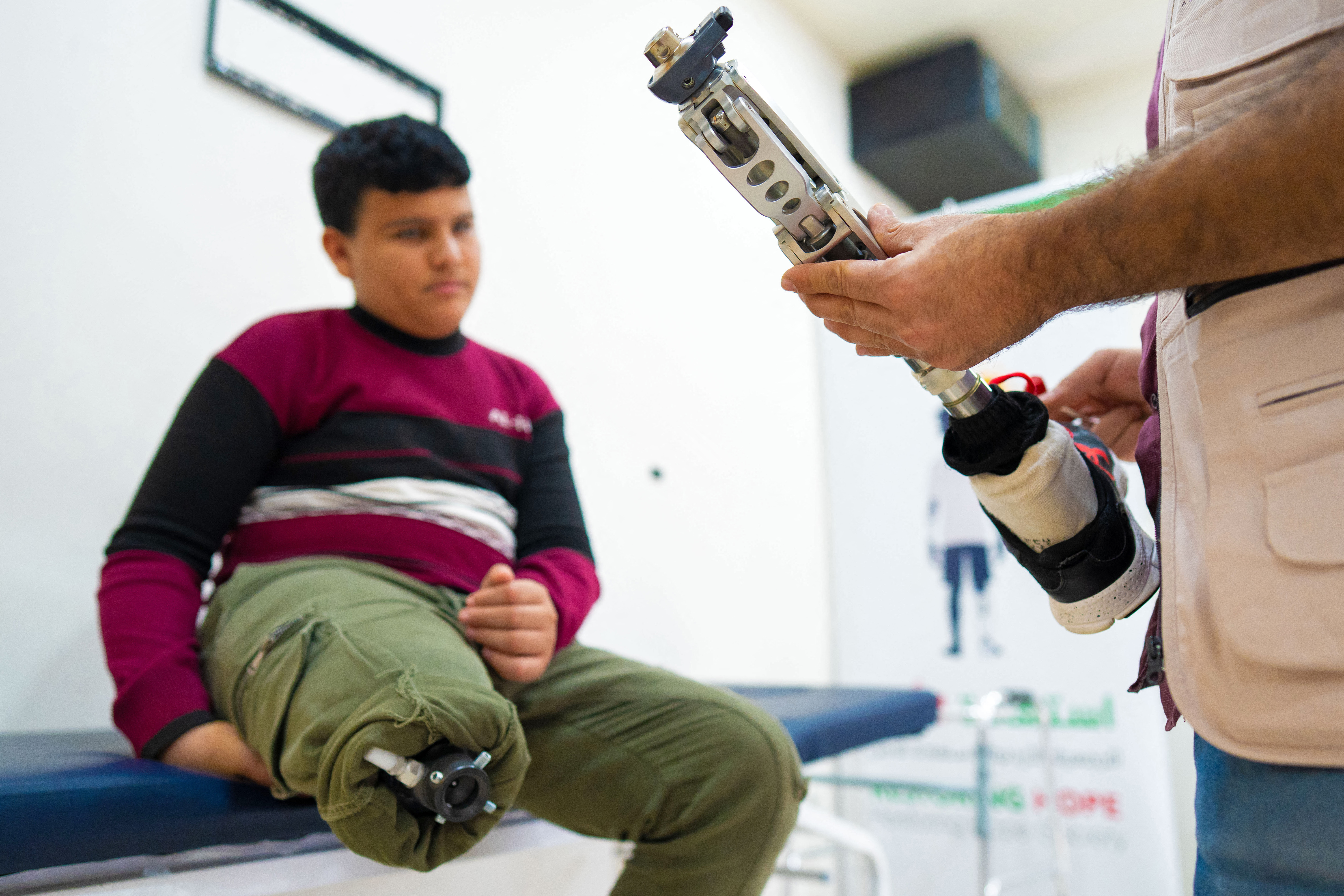
More than 450 Palestinian amputees are receiving medical treatment and artificial limbs through a programme operating in Amman and Gaza, organised by Jordan’s Restoring Hope Society.
The initiative assists victims of severe trauma caused by the conflict, including children and teenagers who lost limbs after Gaza's devastated healthcare system was unable to manage their worsening injuries.
Among those being treated is 15-year-old Mahmoud Abou Nusair, who lost his right leg below the knee after being struck by gunfire on October 31, 2025, while gathering firewood in central Gaza's Deir Al-Balah during a ceasefire agreed that month. After waiting half an hour for a horse-drawn cart to transport him to Al-Aqsa hospital, he spent two weeks at Nasser hospital in Khan Younis before doctors were forced to operate.
Mahmoud, whose home and sports equipment were destroyed in the war, recalled his initial reaction to the amputation. “My first reaction was to scream,” he said. “Then I took a look at the injured people around me in the hospital. They all had amputated arms and legs, so I told myself: my injury is better.”
Another patient at the Amman facility, 17-year-old Zuhdi Abou Shanab, lost his entire right leg following a strike on September 8, 2025, that killed nine people and injured 28. Zuhdi was on an errand to buy groceries when an adjacent building was hit. Doctors attempted to reattach severed veins and arteries, but the operation failed after an infection took hold.
“The war has devastated us and torn us away from our friends... there is nothing left,” Zuhdi said, adding that he still hopes his condition will improve so he can return to Gaza and reunite with his family.
The programme also aids families wounded in single attacks. Imad Rihan, 42, and his son Abdulrahman were critically hurt when their home in northern Gaza's Jabalia was bombed on January 12, 2025. Three of Imad's other sons were also wounded in the strike.
Imad, who lost his left leg, described undergoing surgical procedures in Gaza without anaesthetic amid severe medical shortages. “No matter how much we talk about the war, or how much you have seen of it, all of this remains but a drop in the ocean compared to the reality that we witnessed with our own eyes,” he said.